


Cat’s Claw Benefits: 6 Possible Uses and What the Evidence Says
What is cat’s claw?
Cat’s claw, or “una de gato”, is a woody vine from the Amazon rainforest named after the hooked thorns that look like a cat’s claws. The bark of two species, Uncaria tomentosa and Uncaria guianensis, has been used in South American folk medicine for centuries. In this article we review the possible cat’s claw benefits and separate what has small human trials behind it from what has only been seen in the lab.
Cat’s claw is a herbal supplement, not a medicine, and the research is still limited. That is why we describe cat’s claw benefits cautiously here, without any promise of a cure.
What is in cat’s claw bark?
The bark contains compounds called oxindole alkaloids, plus polyphenol antioxidants and other plant acids. Researchers believe these compounds explain the anti-inflammatory effect seen in experiments, but their concentration varies from one product to another depending on the species and how the bark is prepared, which is one reason why cat’s claw benefits differ between studies.
6 possible cat’s claw benefits
1. Easing knee osteoarthritis pain
The best-studied of all cat’s claw benefits in humans concerns knee osteoarthritis. In a small trial lasting about 4 weeks, people taking a U. guianensis extract reported less pain on activity than those on placebo. However, the number of participants was small and the trial was short. We cover this in detail in cat’s claw for arthritis.
2. Add-on support in rheumatoid arthritis
In another small trial in people with rheumatoid arthritis who continued their usual treatment, a U. tomentosa extract was linked to a modest drop in the number of painful joints. The key point is that it was used as an add-on, not a replacement.
3. Anti-inflammatory effects in the lab
Cell studies show that cat’s claw extracts may lower some inflammatory messengers such as TNF-alpha. These results are interesting, but they do not guarantee the same effect inside the human body.
4. Effects on the immune system
Many people promote cat’s claw benefits for immunity, and the Solaray label mentions immune system support. Yet most of this evidence comes from laboratory and animal studies, and human data are few and small. For the same reason, cat’s claw is not suitable for people with autoimmune disease or an organ transplant.
5. Antioxidant activity
The bark contains antioxidant compounds that may, in theory, help protect cells from oxidative stress, but this is one of the cat’s claw benefits that has no clear clinical results yet.
6. Digestion
Cat’s claw has been used traditionally for digestive complaints, and the Solaray label mentions digestion, but the scientific evidence for this among the cat’s claw benefits is very weak.
What does NCCIH say about cat’s claw benefits?
The US National Center for Complementary and Integrative Health (NCCIH) states that there is not enough evidence to support cat’s claw for other health conditions, such as preventing infections, cancer or Alzheimer’s disease. Treat any claim beyond the uses above with real caution.
How to get cat’s claw benefits safely
| Product | Content | Label directions |
|---|---|---|
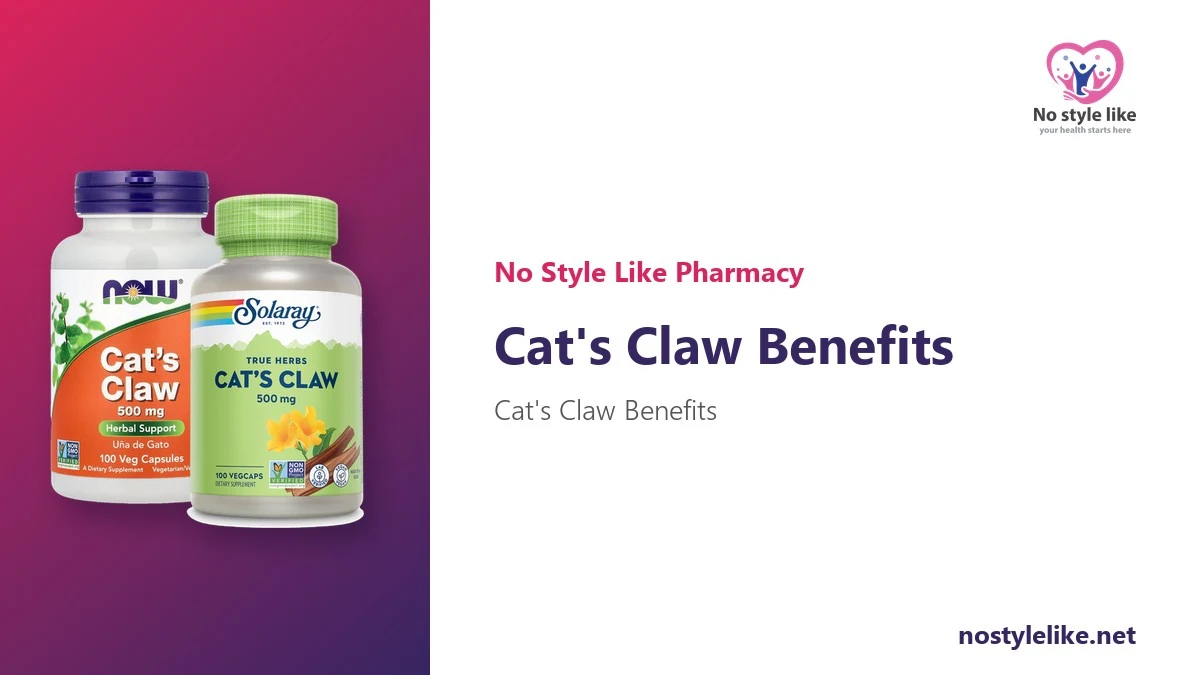
| NOW Cat’s Claw 500 mg | 500 mg cat’s claw bark per capsule, 100 veg capsules | 2 capsules 2 to 3 times daily, preferably with food; adults only |
| Solaray Cat’s Claw 500 mg | 500 mg cat’s claw bark per capsule, 100 VegCaps | 1 VegCap three times daily with a meal or glass of water |
NOW Cat’s Claw provides 500 mg per capsule; the label directions are 2 capsules 2 to 3 times daily, preferably with food, and it is not recommended for pregnant or nursing women. Solaray Cat’s Claw is taken as 1 capsule three times daily with a meal, and it is not for use during pregnancy or when trying to conceive.
- Speak to your doctor first if you take any regular medicine.
- Do not exceed the dose on the label.
- Stop it at least 2 weeks before any planned surgery.
- Watch for any new symptoms during the first weeks.
Who should not take cat’s claw?
It is not suitable during pregnancy, breastfeeding or when trying to conceive, nor for people with autoimmune diseases, an organ transplant or immunosuppressant treatment. Extra care is needed with blood thinners and blood-pressure medicines. We explain this fully in cat’s claw side effects. For other ways to support ageing joints, see joint pain relief for seniors.
Frequently asked questions about cat’s claw benefits
How long do cat’s claw benefits take to appear?
Joint trials measured results after about 4 weeks or longer. If you notice no improvement after 2 months, there is little reason to continue.
Can it replace arthritis medicines?
No. It is not a substitute for treatment prescribed by your rheumatologist.
Is it suitable for children?
No. Both products are intended for adults only.
Conclusion
The best-supported cat’s claw benefits are a modest easing of knee osteoarthritis pain and add-on support in rheumatoid arthritis, both from small trials, while the immune claims rest mostly on lab work. Use it carefully and after talking to your doctor. You can find NOW Cat’s Claw and Solaray Cat’s Claw at No Style Like pharmacy.
This article was reviewed by the No Style Like pharmacy content team. It is for general awareness only and does not replace advice from your doctor or pharmacist.
Do not use cat’s claw during pregnancy, breastfeeding or with autoimmune disease without medical advice. For more information see the NCCIH cat’s claw page.