


Types of Dermal Fillers: 5 Examples From Volume to Lips and Lines
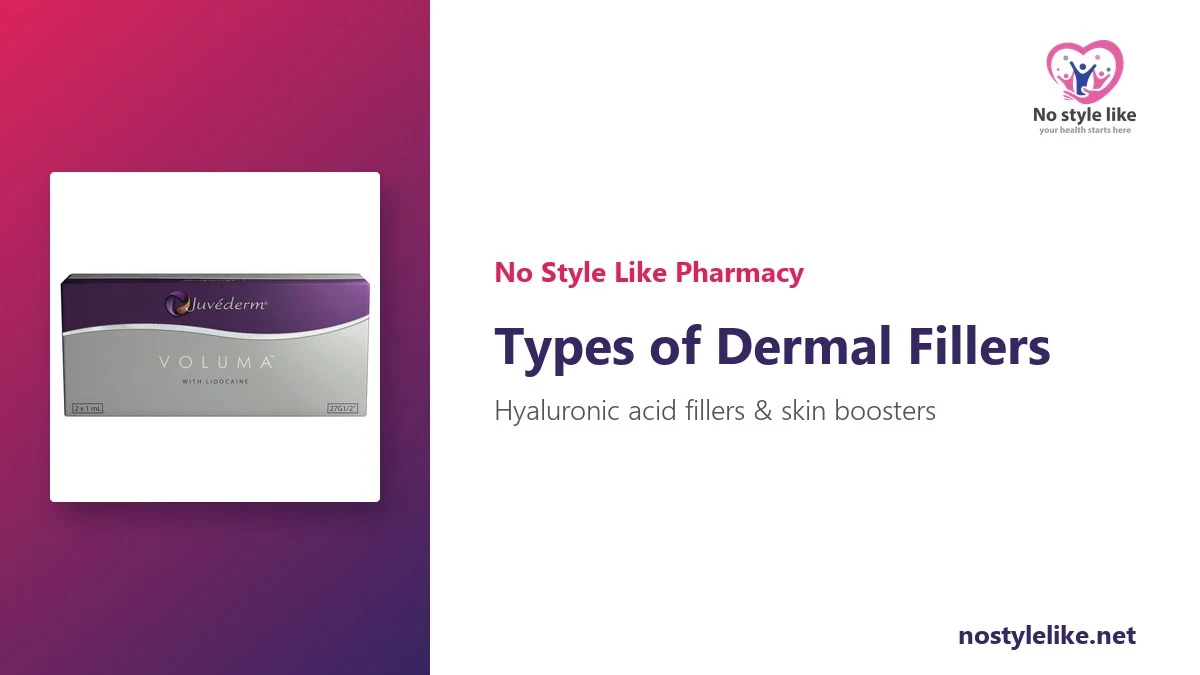
Types of Dermal Fillers: Why One Gel Does Not Fit Every Area
A dermal filler is a sterile gel injected under the skin to restore volume or soften lines. It is a prescription medical device for professional use only, injected by a trained dermatologist or plastic surgeon in a clinic after an assessment, and never self-injected at home. The main types of dermal fillers differ in hyaluronic acid concentration, cross-linking and gel firmness, and therefore in the area each product suits. This guide explains the differences simply, using 5 products available at No Style Like Pharmacy as examples. Choosing the product and the amount is always a medical decision.
What Is a Hyaluronic Acid Filler?
Hyaluronic acid (HA) occurs naturally in the skin and binds water. In a filler it is cross-linked so it stays in the tissue for months instead of breaking down within days. Higher concentration and cross-linking give a firmer gel with more support, while lower values give a softer, more flexible gel. A practical advantage of HA gels is that a doctor can dissolve them with the enzyme hyaluronidase if needed, and many contain lidocaine 0.3% to make the injection more comfortable. Most types of dermal fillers used today are built on this ingredient.
Types of Dermal Fillers by Thickness and Purpose
In practice, the HA-based types of dermal fillers fall into three broad groups, plus skin boosters, which are not volumising fillers in the strict sense:
| Type | Typical use | Examples | Composition |
|---|---|---|---|
| Deep volumiser | Cheeks, chin, temples, jawline | Juvederm Voluma, Aliaxin SV | HA 20 mg/ml with lidocaine; HA 25 mg/ml without lidocaine |
| Deep folds and lips | Nasolabial folds, marionette lines, lip volume | Juvederm Ultra 4 | HA 24 mg/ml with lidocaine |
| Flexible gel for dynamic lines | Moderate lines around the mouth, subtle lip enhancement | Teosyal RHA 2 | RHA 23 mg/ml with lidocaine |
| Skin booster | Skin quality, elasticity, hydration | Croma PolyPhil | Polynucleotides 40 mg per 2 ml |
1. Deep Volumisers: Voluma and Aliaxin SV
Juvederm Voluma with Lidocaine by Allergan contains cross-linked hyaluronic acid 20 mg/ml (VYCROSS technology) with lidocaine hydrochloride 0.3%. It is injected deep to restore or create volume in the cheeks and midface, to project the chin and jawline and to fill temple hollows, according to the labelling in different markets. The box holds 2 prefilled 1 ml syringes with 27G needles.
Aliaxin SV (Superior Volume) by IBSA of Switzerland contains highly cross-linked hyaluronic acid 25 mg/ml of non-animal origin. It is designed to restore volume in the cheekbones, midface and chin. It contains no lidocaine, so the doctor may use separate anaesthesia. The box holds 2 syringes, with the volume per syringe printed on the pack. Both belong to the deep-volume group among the types of dermal fillers.
2. Deep Folds and Lips: Juvederm Ultra 4
Juvederm Ultra 4 is firmer than lighter lip gels and softer than deep volumisers such as Voluma. It contains hyaluronic acid 24 mg/ml (HYLACROSS technology) with lidocaine 0.3% and is injected into the mid-to-deep dermis. Doctors use it for deep wrinkles and folds such as nasolabial folds and marionette lines, and to add lip volume and contour. The box holds 2 syringes of 1 ml. Among the types of dermal fillers, it sits between lip gels and deep volumisers.
3. Flexible Gels for Moving Areas: Teosyal RHA 2
Teosyal RHA 2 by Teoxane of Geneva contains resilient hyaluronic acid (RHA) 23 mg/ml cross-linked with BDDE, plus lidocaine 0.3%, with 30G needles. It is placed in the superficial-to-mid dermis and is designed to move with facial expressions, which makes it one of the types of dermal fillers suited to perioral lines, smoker lines, nasolabial folds and subtle lip enhancement. The FDA approved RHA 2 for moderate to severe dynamic facial wrinkles and folds in adults aged 22 and over.
4. How a Skin Booster Differs From Volumising Fillers
Croma PolyPhil is often discussed alongside the types of dermal fillers, but it is not a volumising filler. It is a skin-quality injectable containing polynucleotides (PN-HPT) 40 mg per 2 ml, or 20 mg/ml. A doctor gives it as intradermal micro-injections in a series of sessions, often 2 to 4 sessions a few weeks apart, to improve firmness, elasticity, hydration and fine crepey lines of the face, neck, decollete and hands. It does not add volume or lift, so it complements fillers rather than replacing them. Because it is not hyaluronic acid, hyaluronidase does not act on it.
Other Types of Dermal Fillers Beyond Hyaluronic Acid
Other categories work differently. Calcium hydroxylapatite gives structure and stimulates collagen, while poly-L-lactic acid stimulates collagen gradually over several sessions. These are not dissolved by hyaluronidase and carry their own considerations that a doctor discusses. Read more in our articles on Radiesse filler and the Sculptra guide.
How a Doctor Chooses Between Types of Dermal Fillers
- Area: cheeks and chin need a firm, supportive gel, while moving areas around the mouth need flexibility.
- Depth: volumisers sit deep, while line gels sit in the dermis.
- Goal: volume and support, smoothing a line, or improving skin quality.
- Medical history: allergies to lidocaine or product ingredients, blood thinners and autoimmune disease.
- Previous treatments: which product was used before, where and when.
Results also last for different lengths of time across the types of dermal fillers and areas, as explained in how long do fillers last. Common and rare reactions, and who should avoid treatment, are covered in dermal filler side effects.
Frequently Asked Questions About Types of Dermal Fillers
Can I buy a filler and inject it at home?
No. These are medical devices sold for clinics and doctors. They must be injected by a qualified doctor in a clinical setting after assessment, and each syringe is single use.
Why do some fillers contain lidocaine?
Lidocaine is a local anaesthetic that reduces pain during injection. Tell your doctor about any allergy to amide local anaesthetics.
Is a polynucleotide booster a replacement for filler?
No. It improves skin quality but does not add volume, and it may complement a filler within the doctor’s plan.
Is a thicker gel always better?
No. The right one is the one that suits the area. A firm gel placed in thin or mobile skin can look unnatural, which is why the types of dermal fillers are matched to the area, not ranked by strength.
Are results guaranteed?
No result is guaranteed. Outcomes vary with the area, the amount, the technique and the person, and a touch-up may be needed.
Conclusion
The types of dermal fillers are not quality grades but tools for different jobs: deep volumisers such as Juvederm Voluma and Aliaxin SV, a gel for folds and lips such as Juvederm Ultra 4, a flexible gel for dynamic lines such as Teosyal RHA 2, and a skin booster such as Croma PolyPhil. The choice belongs to a qualified doctor after an assessment, using a genuine product from a trusted source.
This article was reviewed by the No Style Like pharmacy content team. It is for general awareness only and does not replace advice from your doctor. Dermal fillers and skin boosters are medical devices for professional use only: they are injected by a qualified, trained doctor in a clinical setting and must never be self-injected.
Never self-inject a filler or have it injected by an untrained person, and insist on a genuine product. For more information see the FDA dermal fillers page.