


How Long Do Fillers Last? 5 Factors and the Reported Figures
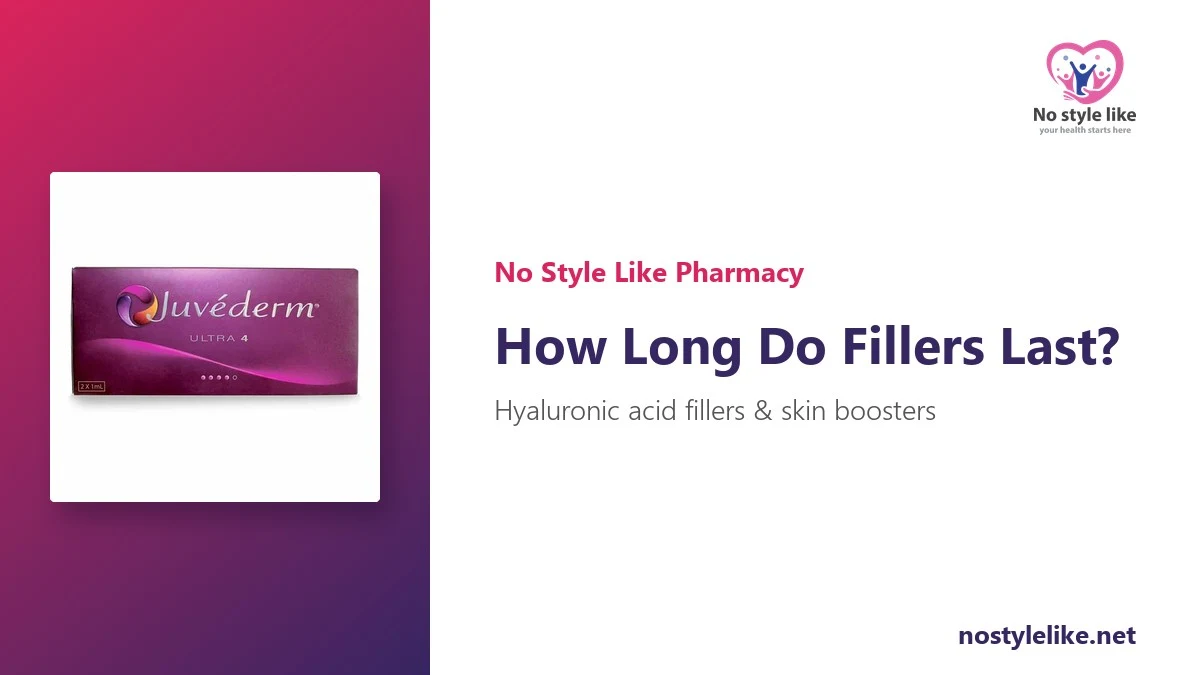
How Long Do Fillers Last, and Why Does It Vary?
One of the first questions people ask before treatment is how long do fillers last. The honest answer is that there is no single number. Manufacturers and studies report approximate ranges, and the real result depends on the treated area, the product, the person’s own body and the injection technique. This article covers 5 factors that affect duration, the reported figures for 5 products, and when a touch-up may be needed. Fillers are medical devices injected only by a qualified doctor, and no result is guaranteed, so asking how long do fillers last is really asking about ranges.
Why Do Fillers Fade Over Time?
Hyaluronic acid is broken down naturally by the body. Cross-linking slows this process but does not stop it. With volumising and line fillers the result is visible straight away, then fades gradually over months until the area returns towards its previous appearance. The rate differs between products and between areas, which is why the question of how long do fillers last never has one answer.
How Long Do Fillers Last? 5 Factors That Decide It
Five factors shape the answer to how long do fillers last:
- The treated area: areas with a lot of movement, such as the lips, usually lose filler faster than more stable areas such as the cheeks and chin.
- The product: concentration, cross-linking and gel firmness differ, and a firm deep gel usually lasts longer than a soft one.
- Metabolism: the speed at which the body breaks the gel down varies from person to person.
- Amount and technique: the depth and amount chosen by the doctor, and their experience, influence the result and how long it holds.
- Touch-ups: a top-up at the right time may help maintain the result, based on the doctor’s assessment.
How Long Do Fillers Last: Reported Figures per Product
The figures below answer how long do fillers last for each product. They are ranges reported in manufacturer data and studies. They are not promises, and your own result may be shorter or longer:
| Product | Use | Reported duration |
|---|---|---|
| Juvederm Voluma | Cheek, chin and temple volume | Up to about 18 to 24 months in the cheeks, per manufacturer data |
| Juvederm Ultra 4 | Deep folds and lip volume | Typically around 9 to 12 months, often shorter in the lips |
| Teosyal RHA 2 | Dynamic lines and folds | Up to about 15 months in nasolabial folds in studies |
| Aliaxin SV | Volume restoration | No fixed figure; varies with area and person |
| Croma PolyPhil | Skin quality, not volume | Given as a series, often 2 to 4 sessions; the doctor plans follow-up |
Product by Product
Juvederm Voluma with Lidocaine is a deep volumiser at 20 mg/ml, and manufacturer data report results in the cheeks lasting up to about 18 to 24 months, depending on the person and area. That is the longest answer to how long do fillers last in this group. Juvederm Ultra 4 at 24 mg/ml typically lasts around 9 to 12 months, with the lips often shorter because they move so much.
Studies of Teosyal RHA 2 reported results lasting up to about 15 months in nasolabial folds. Aliaxin SV at 25 mg/ml is designed for volume, but we do not quote a specific figure because its duration varies with the area and the person; your doctor can explain what to expect in your case.
Croma PolyPhil is different altogether. It is a polynucleotide skin booster that does not add volume, so it is not measured by how long volume holds. It is given as a series, often 2 to 4 sessions a few weeks apart, after which the doctor decides on follow-up. To compare these categories, see types of dermal fillers.
Touch-Ups and Follow-Up Visits
Touch-ups are part of the answer to how long do fillers last. Some people need a small touch-up once swelling has settled, to fine-tune symmetry or complete the amount. Others return for maintenance when the result starts to fade. The doctor decides the timing and amount after examining you, so never add filler elsewhere without telling them what was injected before. Keep a note of the product name, batch number and treatment date, which helps with any later follow-up or complication.
Do not judge the result in the first few days either, because temporary swelling can make an area look fuller than it will be. To learn what is normal after treatment and what needs a doctor immediately, read dermal filler side effects.
Do Collagen Stimulators Follow the Same Timeline?
No. Products such as poly-L-lactic acid work by stimulating collagen gradually over several sessions, with a different mechanism and timeline from hyaluronic acid fillers, so the question how long do fillers last is answered differently for them. Read more in the Sculptra guide.
Frequently Asked Questions: How Long Do Fillers Last?
When do I see the result?
Volume and line fillers show a result immediately, but the final look is clearer once swelling settles over days to about 2 weeks. A skin booster improves gradually across the sessions.
Can I make my filler last longer?
There is no proven way to extend it. When asking how long do fillers last, remember that choosing the right product for the area, following the doctor’s aftercare advice and attending follow-up on time may help.
Can filler be removed before it fades?
A doctor can dissolve hyaluronic acid filler with hyaluronidase if needed. The enzyme does not act on polynucleotides or other categories.
Does repeat treatment change how long fillers last?
Responses vary between people, and the doctor assesses each session based on your situation and what remains from earlier treatment.
Is a longer-lasting filler always better?
Not necessarily. The product must suit the area first; duration is only one part of the decision.
Conclusion
So how long do fillers last? The reported ranges are up to about 18 to 24 months for Voluma in the cheeks, around 9 to 12 months for Ultra 4, and up to about 15 months for RHA 2 in nasolabial folds, while Aliaxin SV varies with the area and person and PolyPhil is given as a series of sessions. These are ranges, not promises. Discuss your expectations with a qualified doctor before treatment.
This article was reviewed by the No Style Like pharmacy content team. It is for general awareness only and does not replace advice from your doctor. Dermal fillers and skin boosters are medical devices for professional use only: they are injected by a qualified, trained doctor in a clinical setting and must never be self-injected.
Figures are reported ranges, not guaranteed results. Only the doctor chooses the product, the amount and any touch-up. For more information see the FDA dermal filler dos and donts.